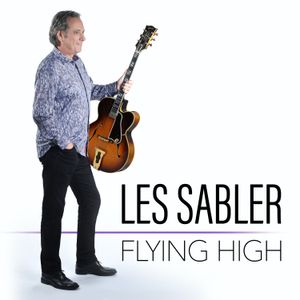

LES SABLER
“Flying High”
When two-time Grammy-winning producer Paul Brown (George Benson, Larry Carlton, Norman Brown, Boney James, Kirk Whalum) agreed to produce contemporary jazz guitarist Les Sabler’s “Tranquility” album, it led to a transformational project by the fretman. With Brown at the helm, Sabler hit a new creative zenith on that 2021 album. For his ninth album, Sabler reunited with Brown to record “Flying High,” which releases February 3, 2023 from New Vista Records.
“I’m at the top of my game, hitting my creative stride on the last album (“Tranquility”). It was such a great experience to have Paul produce ‘Tranquility,” and I was extremely comfortable with his direction and guidance. Without a doubt, it resulted in a landmark recording for me. ‘Flying High’ takes it to another level,” said Sabler who reassembled the same creative team for the new disc.
Brown’s fingerprints are all over “Tranquility” starting with Sabler’s guitar sound. The producer urged Sabler to get a vintage 1967 Gibson Johnny Smith guitar, which reshaped the guitarist’s sound, inspiring his best performances.
“The guitar’s sound is a sonic departure from anything I had previously recorded. My fascination with the expressive tone of this instrument and my comfort in playing it led me to acquire my own, a vintage ‘67 beauty,” said the Nashville-based Sabler, who plays the same guitar on “Flying High.”
Bringing in songwriters Shane Theriot (Hall & Oates, Dr. John, Neville Brothers) and Lew Laing (Norman Brown, Marion Meadows, Raheem DeVaughn) to write songs for “Tranquility” equipped Sabler with richly melodic material incorporating an array of jazz, R&B, funk and pop nuances. The teaming proved to be transcendent, ushering Sabler into the number one spot on the Mediabase chart with the gorgeous and graceful nylon stringed “Esselle’s Dance,” which also hit number five on the Billboard chart. The compelling collection, along with the impassioned and nimble guitarwork featured within, led to Sabler being profiled in Vintage Guitar magazine.
With Brown back in the producer’s chair and cowriting all seven original songs for “Flying High,” Sabler again finds himself keeping frequent company with Theriot (keyboards, rhythm guitar, bass, drum programming), who cowrote five tunes on the new offering, including the album opener, “Over The Top,” a cool and confident midtempo mood-setter that gets an assist from Greg Vail’s whimsical flute.
Exemplifying self-assurance, Sabler stretches his artistic muse on the searing “Compared To What,” a jam recorded by jazz pianist Les McCann and saxophonist Eddie Harris at the famed Montreux Jazz Festival in 1969. In addition to Sabler’s incendiary finger work, this version burns via the firepower of keyboardist Marco Basci, trumpeter Ron King, and Vail’s sax over percolating rhythms cooked up by drummer Joel Taylor, bassist Travis Carlton, and percussionist Lenny Castro.
“I’ve been a fan of McCann’s for decades and was fortunate to meet and spend some time with the legend at the 1990 JazzTimes convention in New Orleans. As luck had it, they put us in adjacent hotel rooms,” Sabler recalled fondly.
Laing (keyboards, bass, drum programming) and Sabler pushed the limits with the single “Keep Pushin’” for “Tranquility,” and their reunion bodes to be equally luminous. “Moonlight” builds on their chemistry as Sabler’s sinewy electric guitar beams amidst the shimmering track.
The title cut ascends on its rousing chorus launched by a Gorden Campbell drum groove. Sabler defers to the warmth of his nylon stringed guitar on “Old Friends,” despite fostering a sense of exotic adventure. “New Bossa,” a multicultural amalgam powered by a vibrantly animate melody, is Sabler’s latest single to instantly dance onto the SiriusXM Watercolors playlist and hit three national jazz charts simultaneously.
Venturing into standards territory, Sabler interprets Academy Award-winning “The Windmills Of Your Mind” from 1968’s “The Thomas Crown Affair” as a somber and sultry staccato Latin groove, using his nylon string guitar to emote eloquently and exchange elegant banter with Lou Pomanti’s (Michael Bublé, Gordon Lightfoot) keyboard poetics. Sabler credits Dusty Springfield’s version as his influence.
Sabler’s inspiration for another modern classic, “Summer In The City,” came from a version Quincy Jones recorded in 1973. Sabler’s reimagination is steamy and creates tension like The Lovin’ Spoonful’s original, but the guitarist is buttressed by a robust horn arrangement that includes Vail’s bellowing saxophone. After, “Soft and Smooth” dials down the intensity. Despite the slower, more deliberate cadence, Sabler’s loquacious guitar licks leap to the fore in a lyrical repartee.
“Double Jeopardy” is seductive, mysterious and alluring, highlighted by Sabler’s nylon string overtures and King’s soulful trumpet coos. Sabler pays homage to one of his influences, guitar legend Kenny Burrell, on “A Child Is Born,” which closes the collection. Burrell recorded the Thad Jones gem in 1971.
“This arrangement differs from the original 3/4-meter as it is performed in straight 4/4, however, it retains the expressive flavor of the beautiful composition,” said Sabler.
Sabler added one key figure to the “Flying High” creative outfit. When it was brought to his attention that Abbey Road Studios mastering engineer Geoff Pesche named “Tranquility” as his favorite album of 2021, Sabler invited Pesche to master “Flying High” in the same studio made famous by The Beatles.
A native of Montreal, Sabler got his start by recording the score for a Canadian Television Network documentary about the lost treasures of the Titanic in 1989, seeding the release of his debut album, “Hidden Treasure,” the following year. Five years went by before he issued his sophomore album, “Time For Love,” and after garnering radio spins and chart action, Sabler began playing concert dates headlining or opening for artists such as Jeff Lorber, Richard Elliot, Spyro Gyra, Michael Lington and Diane Schuur.
In 2003, the title track to Sabler’s third album, “Bridge the Gap,” was his first No. 1 single in his homeland, earning nominations for Album of the Year and Guitarist of the Year at the Canadian Smooth Jazz Awards. Sabler upped the ante on his 2007 next project, “Sweet Drive,” by getting Grammy nominated bassist Brian Bromberg to produce the set of contemporary jazz, R&B and adult pop featuring Grammy winners Jeff Lorber, Vinnie Colaiuta and Jerry Hey along with Grammy nominees Eric Marienthal and Alex Acuna. The collection was nominated as Album of the Year and Sabler scored another Guitarist of the Year nomination from the Canadian Smooth Jazz Awards. The Canadian Indie Awards followed suit with a Jazz Artist of the Year nomination while the country’s “Café Jazz” radio show named Sabler the most played Canadian artist and “Sweet Drive” the most played album by a Canadian artist. The program’s spins led the album’s “Club Street” to become the second most played single by a Canadian artist in 2008.
Sabler returned a couple years later with “Crescent Shores,” which unveiled a new dimension: the guitarist played only a nylon stringed guitar on the album that includes a duet with saxophone star Elliott. The album spent several months near the top of Amazon’s jazz and smooth jazz charts. On his next outing, Sabler again challenged himself and elevated his artistic expression by singing on the 2014 “Jobim Tribute,” which became an Amazon Brazilian jazz and Latin jazz best seller. The lavishly produced project pays loving tribute to iconic Brazilian songwriter Antonio Carlos Jobim. Sabler croons seven songs, occasionally plying his baritone voice in the legendary tunesmith’s native Portuguese, along with five guitar-centric instrumentals in a set list comprised of classics and lesser-known catalogue gems.
Relishing this period of releasing projects exhibiting his creative peak, Sabler is determined to continue the momentum.
“That’s my mission for ‘Flying High.’ It’s about soaring to new heights and staying inspired by crafting the best music of my recording career.”
PERFORMANCE VIDEOS